
Money and gaming: financial skills, gender differences and the perception of control
The new research by Fondazione FAIR and Ipsos Doxa on the relationship between money management and approaches to gaming with cash winnings was presented at the Festival di Open.

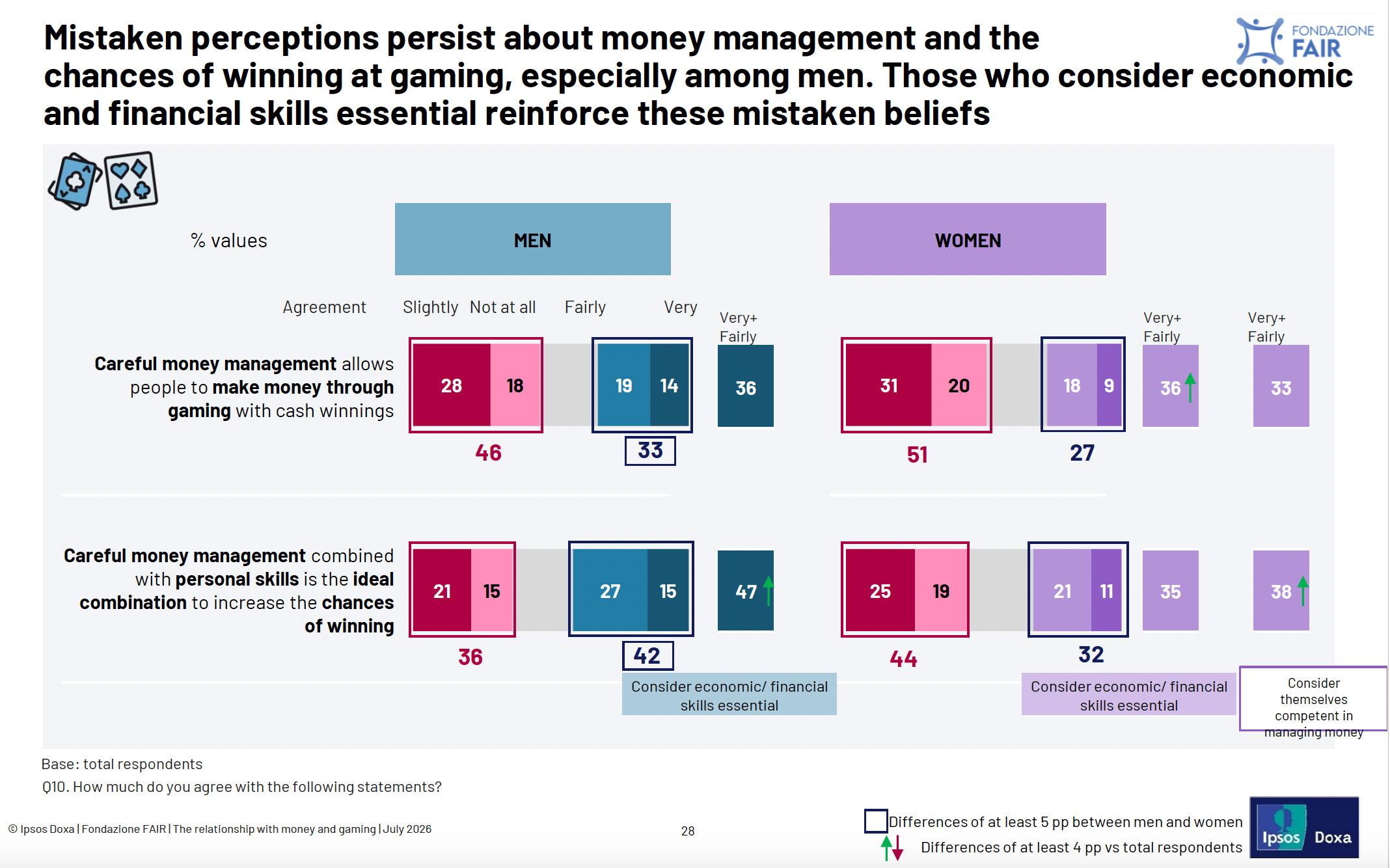
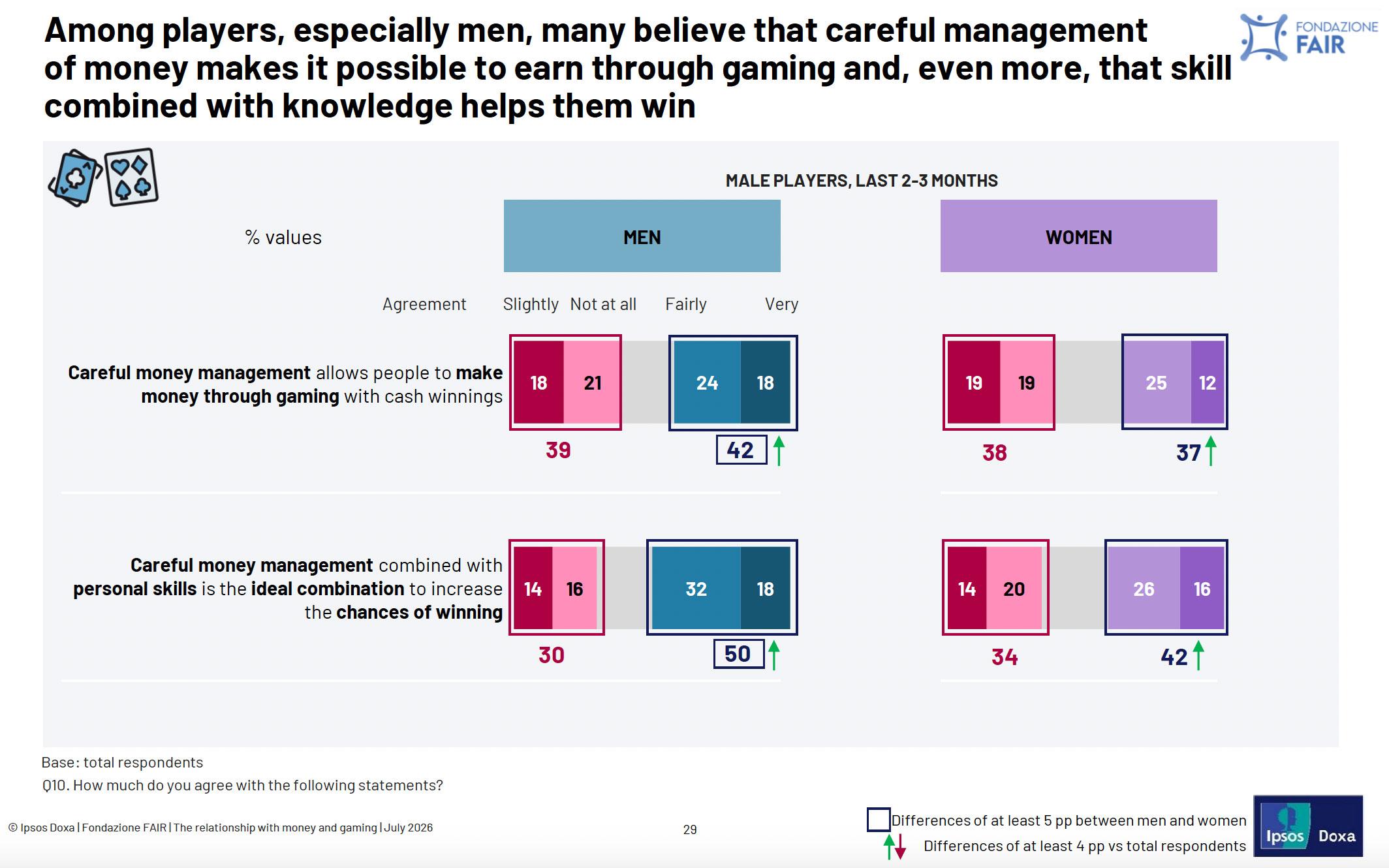
42% of men and 32% of women agree that careful money management, combined with personal skills, is the ideal combination for increasing the chances of winning at gaming. The belief is also common among people who consider financial skills essential.
The research "The relationship with money and gaming: exploring connections across generations" was carried out by Ipsos Doxa and presented in Parma at the Festival di Open by Stefano De Vita, Director General of the Foundation. The survey, based on 1,000 online interviews with people aged 18 to 70, analyses people's experience of money, their spending habits and their views on gaming, with a focus on gender and age differences.
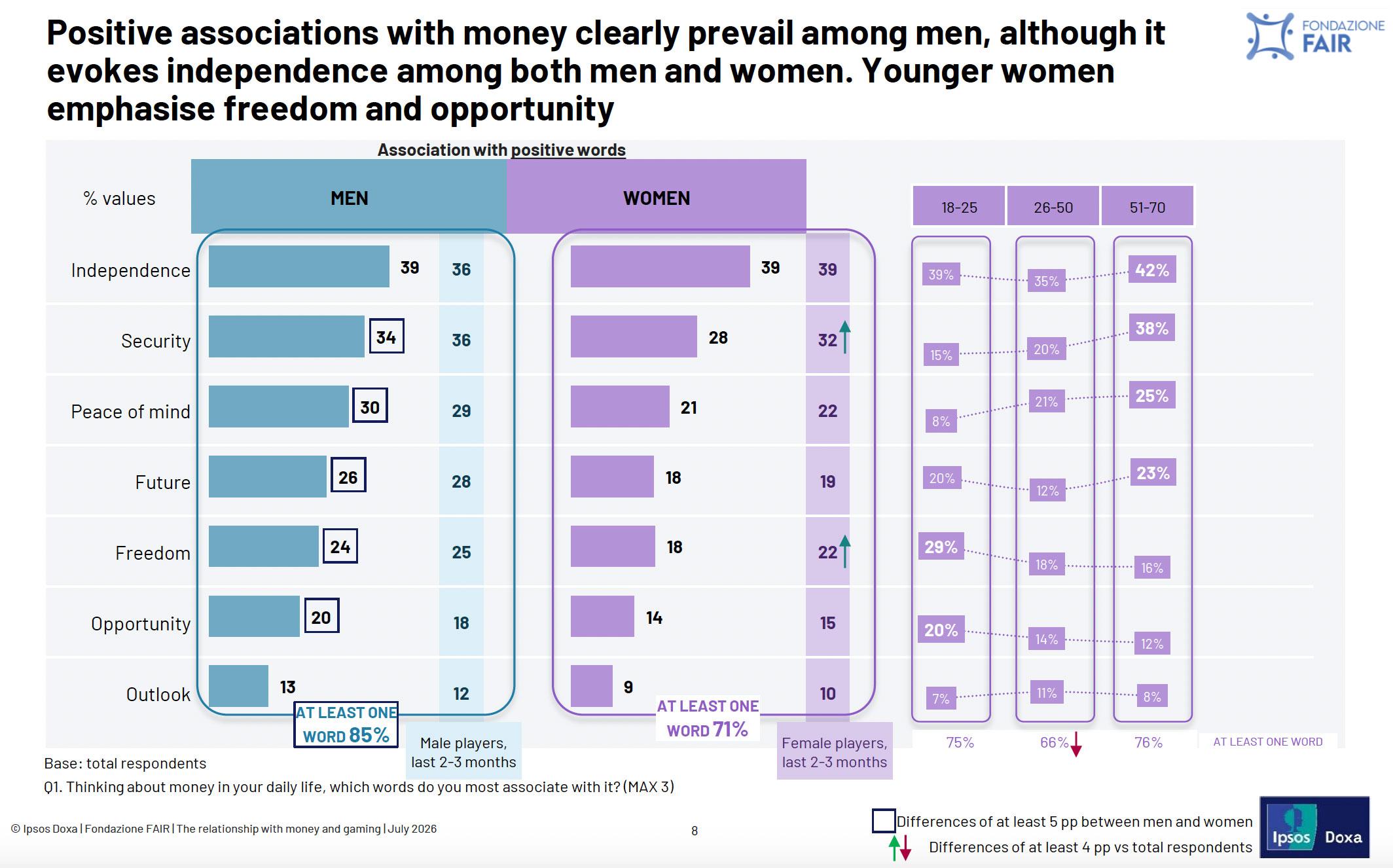
Men and women relate to money in different ways. Independence is a shared association, mentioned by 39% of both groups, but women more often refer to sacrifice and worry. Among women aged 18–25, money evokes freedom for 29%, while only 15% associate it with security and 8% with peace of mind.
Self-assessment of skills also shows a gap: 68% of men and 60% of women consider their knowledge of money management and economic and financial choices to be adequate. Reported habits, on the other hand, are similar: 81% of women and 84% of men say they keep track of recurring expenses, while planning for major expenses concerns 81% and 80% respectively.
Turning to gaming, the research finds broad agreement with the idea that careful money management can help prevent excessive behaviour and set spending limits. However, 33% of men and 27% of women strongly or somewhat agree with the statement that careful money management "allows people to make money through gaming with cash winnings".
These results suggest paying particular attention to the meaning people give to control. Being able to organise one's spending and understanding probabilities are distinct matters, and an educational programme needs to address both explicitly.
In his talk, De Vita stressed: "Good money management can reduce risk and help us stay in control, but it does not make us any better at winning."
The usefulness of financial education is widely recognised, especially for everyday decisions. 86% of men and 84% of women consider it useful for setting a spending limit on leisure activities. When the same question concerns gaming with cash winnings, the figures fall to 72% and 61%.
The research offers input for developing educational content that is closer to people's experience. The areas identified include setting spending limits in advance, protecting the household budget and recognising mistaken beliefs about the chances of making money.
Sign up for our newsletter and keep up to date with Fondazione FAIR