
From Player to Consumer: A Possible Evolution of the Sector

The gaming sector has long aspired to be recognized as a true industry, with rules, standards, and full economic and institutional legitimacy. This is a natural dynamic for a growing and structured market. If we look at it from a microeconomic perspective, the key issue becomes the balance between supply and demand.
On the supply side, the evolution is evident. In just a few years, we have moved from largely manual product management to a fully digitalized ecosystem. The offering is continuous, personalized, and available in real time. Products are certified, systems are regulated, and traceability is more robust than in the past. Customer relationships have also been structured through advanced CRM systems, loyalty programs, and dedicated support tools. Added to this is the emergence of artificial intelligence, which is set to significantly impact both product development and player interaction. The ability to analyze behavior and personalize the experience is set to increase further. The offering has therefore reached a high level of technological sophistication.
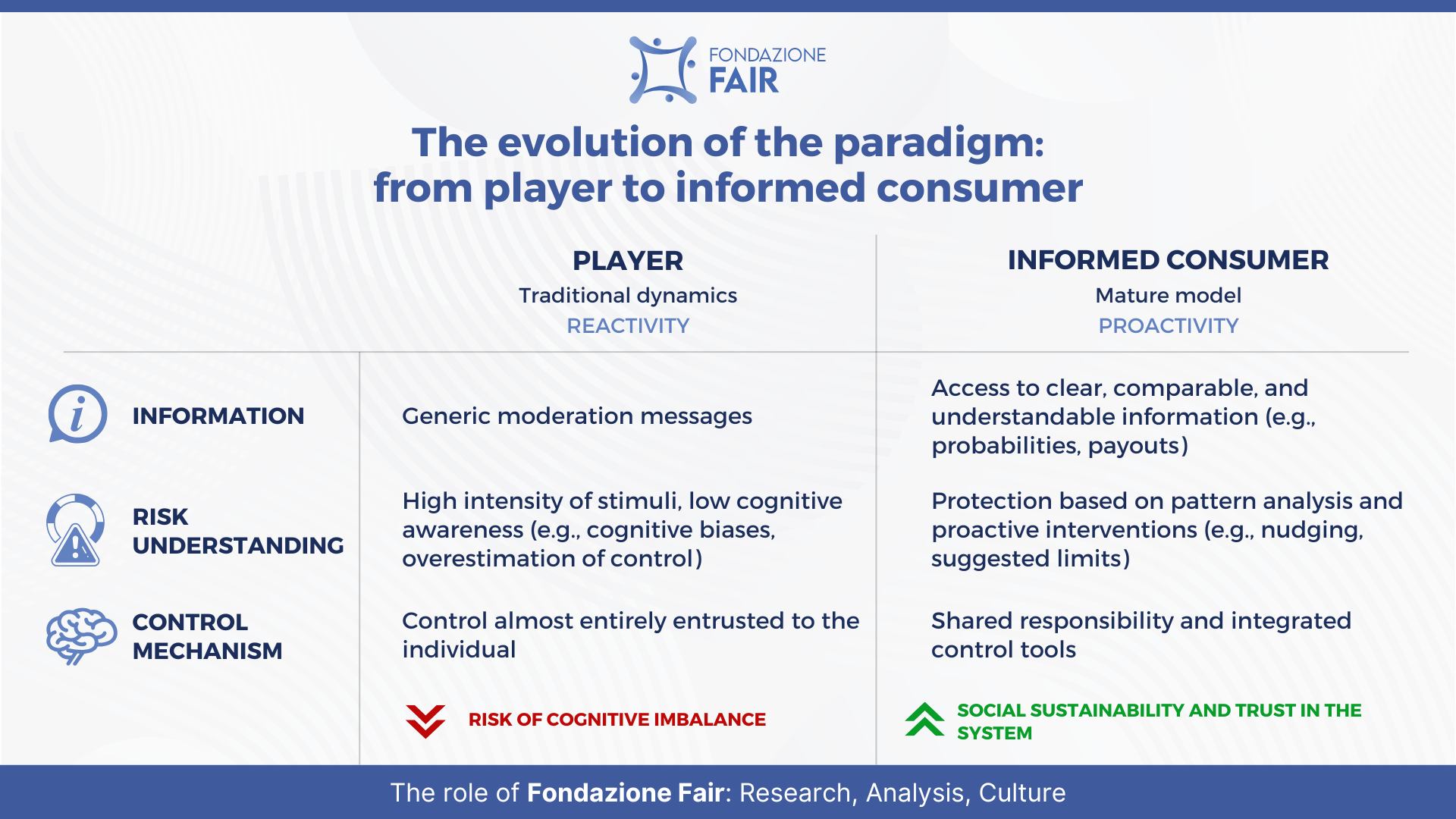
On the demand side, the situation is more delicate. Players find themselves immersed in a highly stimuli-intensive environment, with dynamic and easily accessible products. However, the ability to fully understand probability, loss mechanisms, frequency effects, and the dynamics of gambling is not evolving at the same pace as technological innovation. Research on behavior under risk shows that people tend to overestimate their control over random events and react strongly to losses. In an environment that accelerates decision-making and multiplies gambling opportunities, an imbalance can emerge between the complexity of the offering and the cognitive tools available, especially for the most vulnerable groups.
When it comes to Responsible Gaming, the message is often limited to a general call for moderation, leaving risk management almost entirely up to the individual. A mature model requires a further step. Players must be able to access clear, understandable, and comparable information. The probability of winning, payout mechanisms, product volatility, and the effects of gaming frequency must be communicated in a truly comprehensible manner. In many sectors, third-party providers ensure the accuracy and transparency of information provided to consumers. A reflection along these lines would strengthen trust in the system and help transform players into informed consumers.
Informational awareness alone is not enough. Companies now have analytical tools that enable them to identify patterns of risky behavior. Responsible use of these tools can translate into gradual interventions, personalized suggestions, proactively proposed limits, and pause mechanisms. Nudge techniques, if applied with transparent and measurable criteria, can lead to more balanced gaming practices. Artificial intelligence, in this scenario, is not only a lever for commercial development but can become an integral part of a protection infrastructure.
The new online gaming tender introduces tools that strengthen traceability and control and represents a significant regulatory basis. The difference will be determined by the quality of implementation and the ability to integrate regulatory tools with advanced protection models. The license defines a framework, while the system's culture will determine its effectiveness.
The transition from player to consumer implies a cultural shift. A consumer is informed, has control tools, and operates in a transparent environment. When supply and demand find a balance based on transparency, protection tools, and shared responsibility, the sector strengthens its social legitimacy. The sustainability of gaming is measured by the quality of the protection guaranteed and the ability to prevent excesses through constructive dialogue between operators, institutions, and civil society.
The Fondazione FAIR's contribution lies in this space: analysis, development of standards, and promotion of a culture of awareness that makes the balance between supply and demand a concrete and verifiable objective.
Sign up for our newsletter and keep up to date with Fondazione FAIR