
From rules to behavior: how Artificial Intelligence can strengthen player protection

One of the most relevant aspects introduced by the new online licensing framework concerns the implementation, by operators, of behavioral analysis systems aimed at preventing the risks of problematic gambling. This is an important step, as it signals a potential paradigm shift: from risk management based on static and generalized measures to a dynamic approach built on the observation of the actual behaviors of individual players.
Until now, most responsible gambling measures have relied on tools that are inherently standardized: deposit limits, time or spending limits, self-exclusion, and informational messages that tend to be the same for everyone. These are necessary safeguards that represent a minimum level of protection, but they also show clear limitations. In particular, they often apply uniformly to very diverse groups and, not infrequently, are activated when risk signals have already become quite evident.
The introduction of behavioral analysis models, on the other hand, makes it possible to shift the focus to the player as an individual, observed along their own gambling journey rather than merely assessed against standard thresholds or average values. In this sense, Artificial Intelligence can represent a decisive factor for evolution. Through the ability to process large volumes of data, these systems can detect even minimal changes in gambling behavior — for example in session frequency, duration, deposits, spending, or recurring activity in specific time slots — making it possible to identify situations that warrant attention at an early stage.
The strength of this approach lies not only in its predictive capacity, but in the possibility of building more timely, proportionate, and personalized interventions. No longer a generic form of protection, but a set of actions calibrated to the behavioral profile of the individual player. In this perspective, well-designed nudging strategies can also help increase the effectiveness of responsible gambling measures: a contextualized alert, a prompt encouraging reflection on one’s behavior, or a suggestion to set a voluntary limit or take a temporary break can be far more impactful than a generic message.
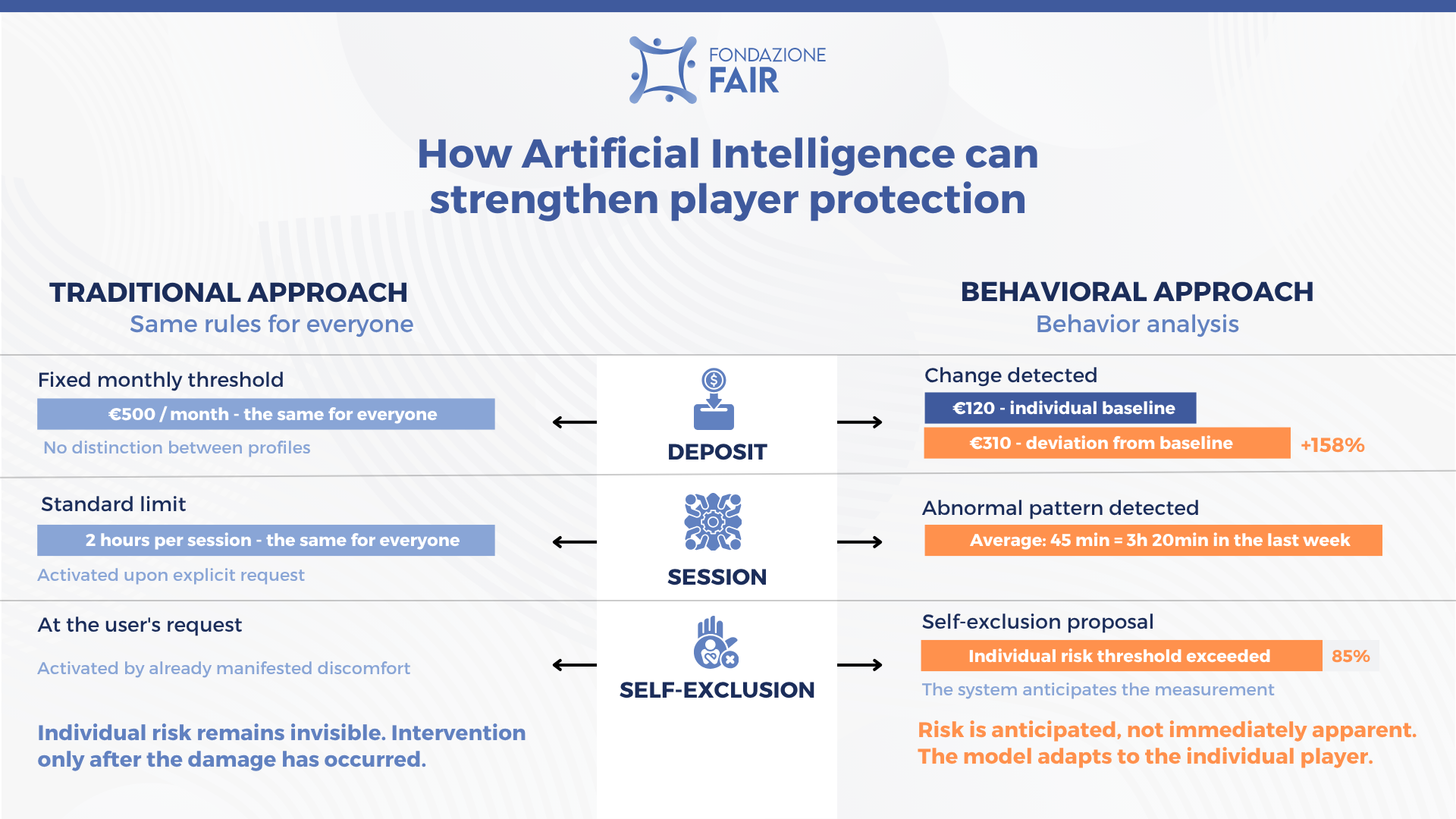
The real innovation, therefore, is the ability to intervene before behavior becomes overtly problematic. Traditional analysis struggles to capture weak signals or gradual changes; an advanced behavioral system, by contrast, can recognize discontinuities that deserve attention even when they have not yet crossed formally critical thresholds. Consider, for example, a player who, over a few weeks, increases the frequency of late-night sessions, abruptly changes spending levels, and shows a growing tendency to raise limits that were previously set voluntarily. None of these signals, taken individually, necessarily indicates a problematic condition; but their combination can represent a significant warning sign, where a timely and “soft” intervention may have concrete preventive value.
These models can become even more robust if they are also informed by evidence from scientific research and by the use of psychological scales and risk assessment tools, such as the PGSI, which can enrich the interpretation of observed behaviors. In other words, technology delivers maximum value when it does not merely classify events, but interacts with the body of knowledge developed in the psychological, behavioral, and social domains. However, this is also where the most delicate issue emerges. The same technology that can be used to protect the player can also be directed in the opposite direction: increasing customer value, intensifying engagement, and maximizing monetization. This is the real strategic and regulatory challenge.
AI, in itself, is neither protective nor harmful: it depends on the objectives assigned to it, the metrics that guide the models, and the governance framework within which it is used. For this reason, it is not sufficient to state that the sector will adopt more advanced tools. It is necessary to clarify who decides when to intervene, based on which indicators, with what priorities, and under what oversight. If models are designed in a context where the logic of the player’s economic value prevails exclusively, the risk of ambiguity is evident. If, instead, they are embedded within a framework of shared rules, common metrics, and principles of transparency, AI can become a truly advanced protection tool.
From this perspective, it will be essential to define shared regulatory guidelines on the use of these systems, establish consistent criteria for identifying risk profiles, and introduce forms of accountability capable of verifying not only the existence of these tools but also their actual impact. The issue is not only technological: it concerns governance, the balance between different interests, and ultimately responsibility toward the player.
It is precisely here, in our view, that the most important crossroads for the sector lies. The ongoing evolution can either limit itself to adding new technological requirements to an already existing framework, or it can help transform responsible gambling from a regulatory obligation into a lever for industrial, reputational, and social sustainability. The difference between these two outcomes will depend on the ability to adopt a coherent vision: using technology not only to make the business more efficient, but to make the entire system more mature, transparent, and responsible. In this transition, it will be crucial to promote an approach centered on scientific evidence, methodological transparency, and impact measurement. It is on this ground that responsible gambling can make a real qualitative leap: not as a set of formal measures, but as an advanced system for player protection.
Artificial Intelligence can represent an extraordinary opportunity, but only if its use is clearly oriented toward the protection of the individual. For this reason, now more than ever, convergence is needed between regulators, operators, and institutional stakeholders, so that technological innovation becomes a tool for responsibility and not merely for efficiency.
Sign up for our newsletter and keep up to date with Fondazione FAIR